

So I Assume You're Getting the Salad
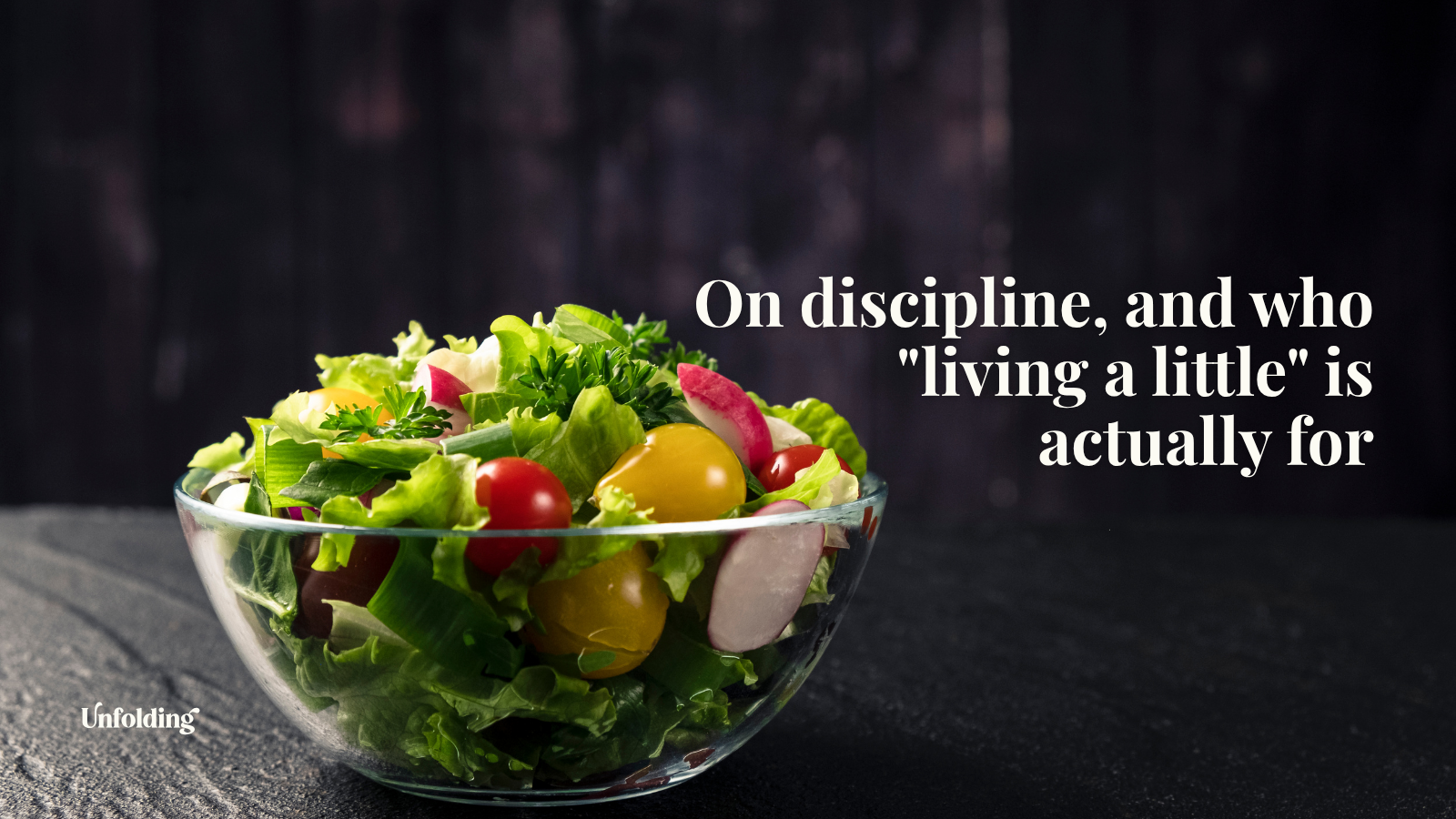
"So I assume you're getting the salad?"
I hadn't even opened the menu.
Someone across the table asked it lightly, almost affectionately, the way you'd ask a running joke, and for a second I felt the old flinch. Am I the rigid one at this table? Am I the woman who can't just have a good time? There is a very specific kind of quiet that follows a question like that, where everyone has already decided who you are before you've said a word, and some small part of you starts scrambling to prove them wrong just to make the discomfort go away.
The truth is, I am, in fact, the one who orders the salad. Almost every time. They aren't wrong about me. If anything, they know me well enough to guess my order before I do.
So it isn't the accuracy that stings. It's the delivery.
There's a version of that question asked with real curiosity, or none at all, just someone glancing at a menu and asking what looks good. And then there's the version I'm talking about, the one with the small lift at the end, the one that isn't really a question so much as a verdict dressed up as one. Of course you are. Said with a smile, usually. Meant, I think, mostly as affection. But underneath the affection is something that has nothing to do with me at all, a flicker of something closer to must be nice, or must be exhausting, or I wish I could say no to the bread and actually mean it.
I don't think most people asking it know that's what they're doing. I have learned to hear the difference between being known and being quietly measured against, and it took me years to stop absorbing the second one as if it were mine to fix.
I used to order something else, just that once, just to blur the line a little, so the question wouldn't have such an easy answer next time. As if my discipline were a burden I was placing on the table and it was my job to lighten it for everyone else's comfort.
It isn't. It was never mine to lighten.
My choices impact me. Not you. Me.
I know, with precision, exactly how certain foods make me feel hours later. Foggy. Heavy. Low. Unlike myself. So when I order the salad, I am not restricting anything. I am choosing the version of tomorrow morning I actually want to wake up to. That isn't deprivation. That's closer to the truth of what taking care of myself actually requires, even when it doesn't look like ease at a dinner table.
Nobody raises an eyebrow anymore when I turn down wine altogether. I don't drink, by choice, and most people know that about me now, file it away as a fact and move on. It doesn't read as rigid. It reads as settled. But say no to the bread basket at the same table, among the same friends, and suddenly you're the one who can't just live a little.
The salad is just the easiest example to tell, because it happens at a table, out loud, where everyone can hear it. But I have felt some version of that same flicker in a dozen other rooms. In the host who takes a second no personally, who holds out a fork and says one bite won't kill you. In the friend who mentions my five a.m. workout like it's a small accusation, like I've somehow made their own morning look worse by comparison. In the family member who says must be nice about an early bedtime, in a tone that makes it clear they don't mean nice at all.
I don't think that's really about any of us. I think discipline, once it's visible, becomes a kind of mirror. People don't always love what they see reflected back, and it is not my job to dim the glass so the reflection is easier to look at.
I’ve started to wonder who "living a little" is actually for. Because it’s rarely offered as an invitation. More often, it's a request. A quiet ask to come back down to a place where everyone's choices look a little more alike, where nobody's restraint is sitting there next to someone else's second helping, saying nothing, meaning everything.
If you recognize the flinch, here is what I wish someone had told me sooner. The discomfort you feel in that moment is not proof you are doing something wrong. It is proof you are doing something that costs you something, which is a different thing entirely. Try acknowledging it, even just to yourself, the next time it happens. Not out loud, not as a confrontation. Just enough to catch it before you order the thing you don't actually want.
And if you’re the one who asks, more often than you'd like to admit, some version of that question, I would only ask you to notice what's underneath it the next time it rises. It might not be about the other person at all. It might be a flicker of your own wanting, dressed up as a joke because that felt safer than saying it plainly. There is nothing wrong with wanting more ease, more indulgence, more softness in your own life. But that want was never anyone else's to solve, any more than my discipline was ever anyone else's to lighten.
I love the people who ask me about the salad. This was never really about them. It's about the years I spent flinching at a question I already knew the answer to, and calling that flinch politeness.
I don't flinch anymore. Most days.
And when I do, I order the salad anyway.